As fundraisers, we’re being short-sighted as to what donors really want. Here’s an example.
The Juilliard School of Music replaces each Steinway piano after 87 years of use. They would like to shorten that cycle but there’s a marvelous story about the impact of giving buried in that factoid.
When asking a donor to give enough to buy a new piano, schools of music can point to the long life of each instrument and say:
- Imagine the difference you could make over the next 80 years,
- How the addition of each piano strengthens the whole, and how the whole strengthens our appeal to prospective students and faculty
- How many promising students will find their signature and their full promise while practicing on the piano you have provided
- How many parents will be so grateful to see their children rise to their full capabilities by having access to an exquisite instrument
- How many students and professors will compose and premiere new works on it
- How many visiting distinguished pianists will perform on it in master classes and in campus concerts
- How many concert goers will thrill from the artistry that your gift will have been instrumental in developing
- How the world of music and our culture will be enriched in unimaginable ways with every passing year
Exploring and projecting the utility of a gift over time enables donors to see the widening and accumulating impact of their giving. It allows them to see the amount they give as relatively modest when prorated over 80 years of difference-making. This approach makes it possible for donors to see each new piano as an essential increment of enduring greatness and, if they have the means, fund more than one and thereby increase impact further.
This is just an example of how a single fact can be turned into a compelling narrative of impact unfolding over 80 years or more, of how a gift can live on and on.
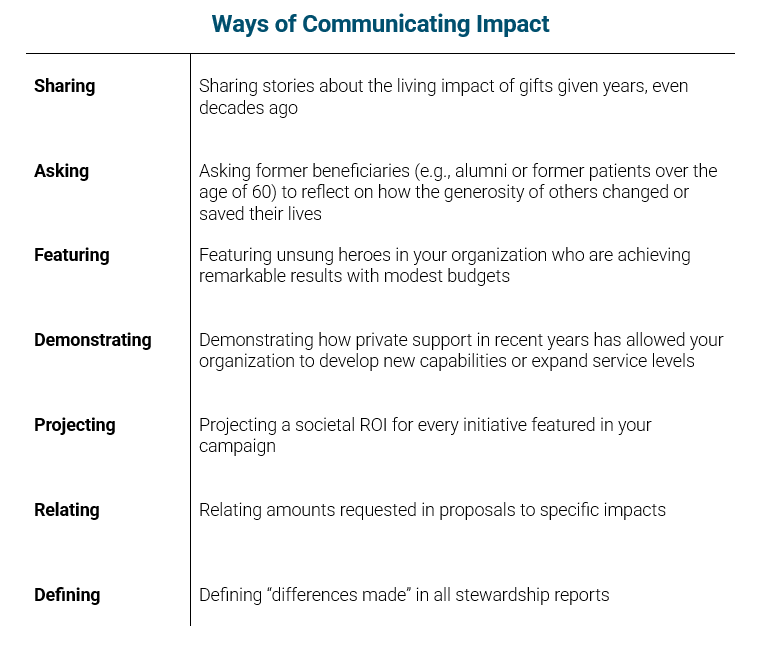
It’s the kind of story so rarely told in fundraising, given our propensity to focus on the immediate. As more donors ask for more evidence of impact, we need to let our reasonable imaginations run out farther and employ more ways of demonstrating impact over time. We’re only scratching the surface of possibilities. Below are a few more suggestions.
Jim Langley is the president of Langley Innovations. Langley Innovations provides a range of services to its clients to help them understand the cultural underpinnings of philanthropy and the psychology of donors and, with that knowledge, to develop the most effective strategies and tactics to build broader and more lasting communities of support. Jim has authored numerous books, including his most recent book, The Future of Fundraising: Adapting to New Philanthropic Realities, published by Academic Impressions in 2020.