When considering a fundraising job offer, make sure to assess the organization’s overall functionality. You can do that by asking the powers-that-be to what extent they have been pleased with recent fundraising results. If they express disappointment, ask what they attribute it to.
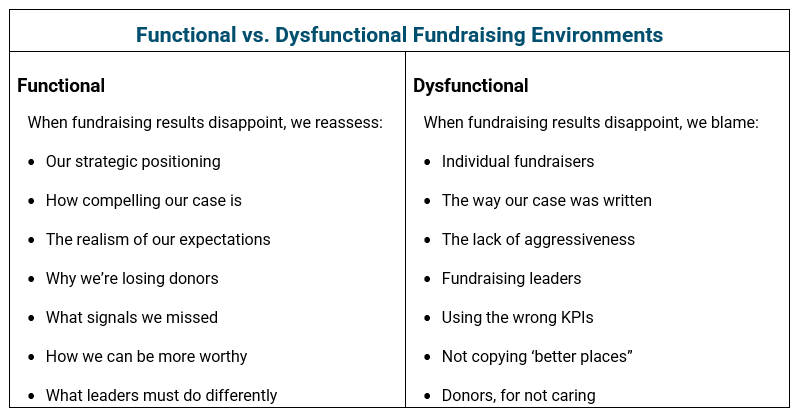
In high-functioning environments, leaders always look at themselves and the systems they have created first. They rethink their expectations and ask if they were rooted in reality. If so, they ask where the system might have broken down. This is true in all fields. Leaders in high-functioning environments don’t blame people; they look for flaws in systems. They know that while some individuals have faltered along the way, significant and sustained failure cannot be traced to the individual in the field, whether it is the fundraiser, the sales rep, or the soldier.
In low-functioning environments, it is the opposite. Brittle leaders can’t look at themselves, or the baselessness of their expectations or the flaws in the systems they created. They blame the individual in the field and even the donor, customer, or client. They speak in terms of what others should do without reflecting on what they could have done better. Good consultants pick up on this right away and determine whether they can be of help.
High-functioning systems correct the course based on objective analyses. Low-functioning feeds on itself, creating a downward spiral that leads to higher rates of turnover for donors and staff. Their leaders’ lack of self-awareness is so pronounced that there is no way to pull out of the slow downward spiral.
Unfortunately, we see more dysfunctional environments than functional ones, so beware. Don’t jump from the frying pan of partial dysfunction into the fire of even greater dysfunction.
Jim Langley is the president of Langley Innovations. Langley Innovations provides a range of services to its clients to help them understand the cultural underpinnings of philanthropy and the psychology of donors and, with that knowledge, to develop the most effective strategies and tactics to build broader and more lasting communities of support. Jim has authored numerous books, including his most recent book, The Future of Fundraising: Adapting to New Philanthropic Realities, published by Academic Impressions in 2020.