The narrative arc
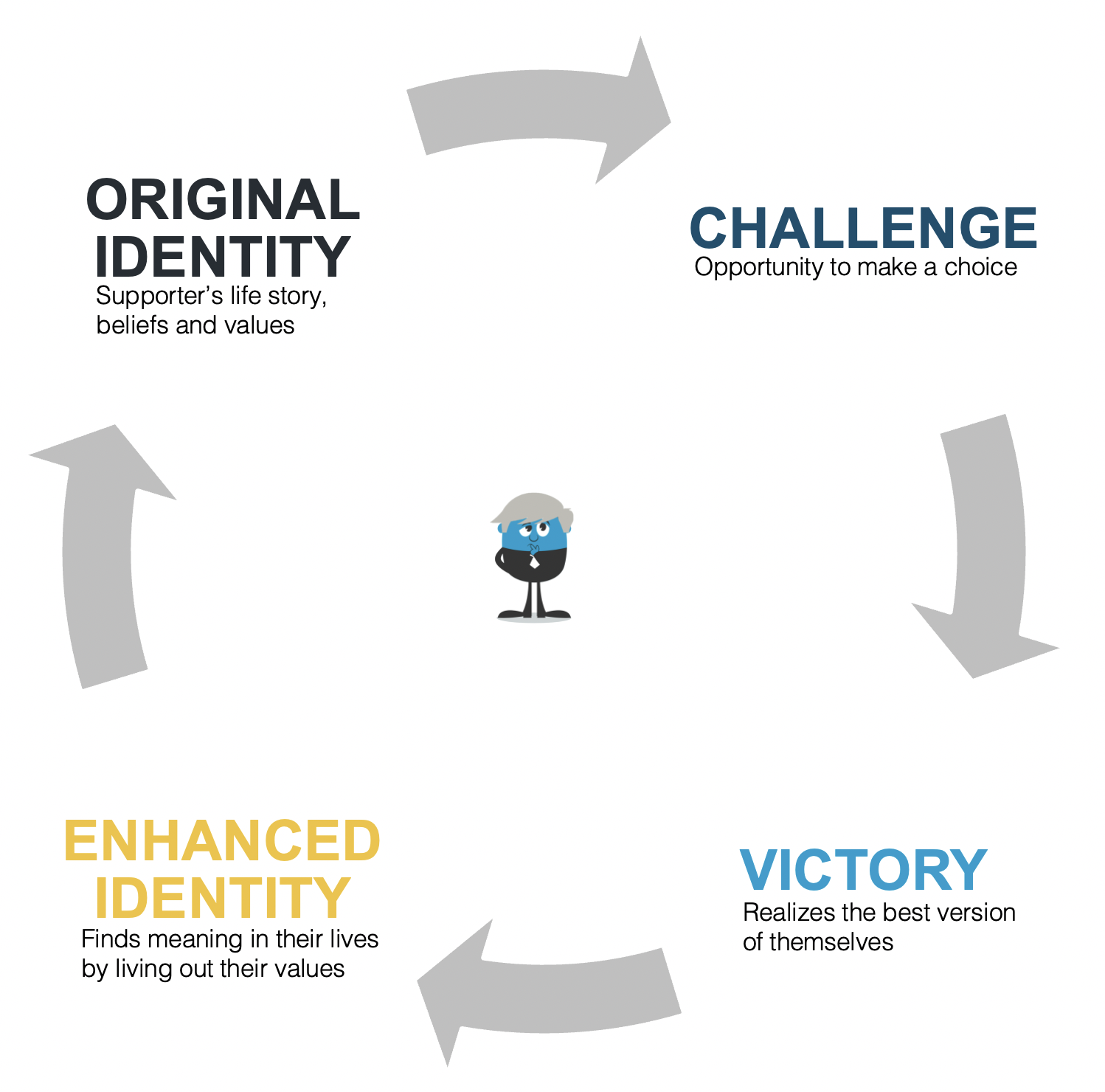
Story moves through a narrative arc. This includes:
- Backstory and setting
These establish motivation from the main character’s original identity. - The inciting incident
This is main character’s challenge. - Climax and resolution
These show the main character’s victory and altered identity.
A key part of a story is the inciting incident. (The main character faces a challenge.)
A key part of a fundraising story is the ask. (The donor faces a challenge.)
A good story needs a compelling inciting incident.
A good fundraising story needs a compelling ask.
Understanding one gives insight to the other.
The inciting incident
The inciting incident kicks off a story’s action. It justifies starting the adventure. It has two parts. First, it must be disruptive enough to cause a big reaction. A minor inconvenience won’t work. Second, it must promise the hope of a victory. Without this, even a catastrophic threat won’t motivate action. Action makes sense only if it can change things.
In simple terms, Big Problem + Potential Solution → Action
The inciting incident needs both problem (negative) and solution (positive). It’s a challenge, but it’s a challenge that promises the hope of victory.
The inciting incident presents:
- A crisis (threat or opportunity) for the main character (i.e., a problem)
- Promising the hope of a victory (i.e., a solution)
- That forces a response[1] (i.e., the action).
Inciting incident descriptions
It starts with a crisis (threat or opportunity). Researchers explain, “But then an event – screenwriters call this event the ‘inciting incident’ – throws life out of balance in the shape of a new opportunity or threat.”[2]
Another researcher likens it to an alarm clock, explaining, “the Inciting Incident is a jolt to the system.”[3]
Another says it “disrupts the homeostasis.”[4] Another calls it simply “trouble.”[5] Robert McKee explains, “the inciting incident is the first major event of the telling of the story that radically upsets the balance of forces in the protagonist’s life.”
This crisis must be urgent and compelling. It can’t be vague or trivial. Otherwise, it won’t force a response. McKee illustrates this point. He writes, “When an Inciting Incident occurs, it must be a dynamic, fully developed event, not something static or vague. This, for example, is not an Inciting Incident: A college dropout … wakes one morning and says: ‘I’m bored with my life. I think I’ll move to Los Angeles.’ She packs her VW and motors west, but her change of address changes nothing of value in her life … If, on the other hand, we notice that she’s created an ingenious kitchen wallpaper from hundreds of parking tickets, then a sudden POUNDING on the door brings the police, brandishing a felony warrant for ten thousand dollars in unpaid citations, and she flees down the fire escape, heading West – this could be an Inciting Incident.”
To motivate dramatic action, the problem must be disruptive. Without a sufficiently disruptive problem, there’s no reason to act.
It’s a crisis (threat or opportunity). But it’s a crisis that promises the hope of a solution. It’s a challenge. But it’s a challenge that promises the hope of a victory. Putting both parts together forces the character to respond.[6]
McKee explains, “Therefore, the Inciting Incident first throws the protagonist’s life out of balance, then arouses in him the desire to restore that balance … the Inciting Incident propels the protagonist into an active pursuit of this object or goal.”[7]
The fundraising ask matches the inciting incident
In fundraising story, the ask is an inciting incident. It’s a challenge to the donor. The effective challenge can start negatively. If nothing happens, a threat may become real. An opportunity may disappear. It’s disruptive enough to force a response.
But it can end positively. The challenge promises the hope of victory over the crisis. The threat can be averted. The opportunity can be realized. Making a gift promises a solution.
It’s negative. Then, it’s positive. It’s problem. Then, it’s solution. Both are needed for the inciting incident. Both are needed for the effective ask.[8]
The effective ask presents:
- A crisis (threat or opportunity) for the donor’s people or values
- Promising the hope of victory
- That forces a response.
Let’s look at experimental research findings for each part.
1. The ask presents a crisis (threat or opportunity)
Crisis (threat)
In experiments, adding a threat can increase giving. For a human rights charity, it increased donations to mention that it “works in countries that have recently passed laws that harshly restrict nonprofit organizations.”[9]
For a cancer research charity, adding that government funding was cut did the same.[10] The threat can come from many places. It might be opposing political groups,[11] natural disasters,[12] or even terrorist attacks.[13] In each case, adding a threat increases donations.
But this threat can disappear. If the crisis fades, so does the inciting incident. Thus, the fundraiser may also face a deadline. This can happen with natural disasters or social and political events.[14] Giving willingness is high when the threat is present, but then it fades.
This can also happen at a personal level. One study looked at 18,000 donation requests from a hospital.[15] These were to former patients. The study found that “an extra 30-day delay between the provision of medical care and a donation solicitation decreases the likelihood of a donation by 30%.”
There is a window to engage “grateful patients.” But with time, the threat fades and the window can close.
Crisis (opportunity)
It’s easiest to think about the inciting incident as a threat. However, an opportunity can also be disruptive. It can also serve as an inciting incident. So, which works best in fundraising? A review of 27 studies found that either can work equally well.[16] But different messages may appeal to different audiences.
One study asked for donations to support an art exhibit.[17] One request mentioned a threat that the exhibit might be discontinued. This increased giving by 40%. Threat worked. Another mentioned an opportunity to create a similar exhibit elsewhere. This increased giving by 73%. Opportunity worked too.
But different groups responded differently. The threat message worked better for frequent attendees. They had more “ownership” in the museum than the casual visitor. The threat of loss meant more for this group.[18]
Main character’s crisis
In the inciting incident, the action is prompted by a crisis (threat or opportunity). But this must be a crisis for the main character. Otherwise, it won’t motivate action.
The fundraising ask is similar. The donor’s action is prompted by a crisis (threat or opportunity). But this must be a crisis for the donor’s people or values.
Suppose the people or values involved don’t matter to the donor. That means the crisis doesn’t matter either. If the donor doesn’t identify with these people or values, the crisis won’t motivate a gift.
2. The ask promises the hope of a victory
Negative then positive messages
A good inciting incident has two parts. The crisis (threat or opportunity) disrupts the character’s world. But the response promises a positive result. The challenge promises the hope of a victory. It’s problem then it’s solution. It’s negative then it’s positive.
The negative-positive sequence can be powerful in fundraising. One eye-tracking study showed this. It tested four online advertisements for a children’s charity.[19] The top half used either
1A) A sad child with a negative message,[20] or
1B) A smiling child with a positive message[21]
The bottom half combined each with either
2A) A negative story with a sad child, [22] or
2B) A more positive story with a smiling child[23]
Of the four combinations, the most effective (1A+2B) started negative but ended positive.[24] This captured the greatest attention, as measured by eye-tracking software. It also created the highest positive emotion at the end. This, in turn, increased both empathy and intention to donate.
Matching the positive outcome with the negative disruption
The inciting incident is a disruption. It “first throws the protagonist’s life out of balance.” [25] This leads to, “the desire to restore that balance.” [26] This combination motivates action.
But the two parts must match. The solution must match the problem. The positive must address the negative. This is also true on an emotional level.
One experiment tried ramping up a negative emotion. Some people first described a situation in which they felt angry. This increased later donations, but only for certain gifts.
Increasing anger worked if the gift promised justice. It worked if the gift restored the harm done to a victim.[27] The victory satisfied the emotional imbalance.
But increasing anger didn’t work if the gift just generally helped people. That victory did not address the emotional imbalance. The two parts didn’t match, so they didn’t motivate action.
Finish the story
Another study again showed the power of the negative-positive sequence. It started by describing a person in need.[28] This created negative emotions. Following this with an option to donate changed things. It created “anticipated positive emotions.” It created hope. Next, making the gift then created even more positive emotions. The emotional journey was negative, then positive.
But the story wasn’t finished. With no feedback on the gift’s usage, the donors’ emotions again turned negative. Giving detailed feedback had the opposite effect. It improved emotions and future donation intentions.
The donor experience wasn’t just about the ask. It was also about the rest of the story. If the charity didn’t finish the story, the experience turned negative again.
Giving can be an emotionally rewarding experience. But it’s risky. The ask starts negatively. But a good ask promises the hope of a victory. If the charity delivers on that promise, the story ends positively. If the charity fails, the story starts and ends negatively. This risk matches some people’s ambivalence about being asked.
3. The ask forces a response
Negative feelings
A story needs an inciting incident. Fundraising needs an ask. Forcing a response works. Asking works. Lab and field experiments both confirm this.[29] So does practical experience.
But that doesn’t mean asking is always easy. It doesn’t mean being asked is always appealing. The ask can start negatively. Even with the hope of victory, it puts the donor at risk. The charity might not finish the story. There may be no happy ending. As a result, some will prefer to avoid being asked.
Avoiding the ask
One experiment used Salvation Army bell ringers at a store entrance. They were told to make eye contact and say, “Please give.” This worked. Donations increased by 50%.[30] But many people avoided it. One third of those who would have used that entrance, instead chose another door.[31]
Given the chance, many will choose to avoid the ask. But that doesn’t mean they shouldn’t be asked. One experiment tested this. It conducted door-to-door fundraising. But it gave some people a warning. They first received a flyer. It had an opt-out box and the time of the upcoming visit. What happened? This flyer reduced door opening by 23%.[32]
This seems efficient. It eliminates those who didn’t want to be asked. But it was bad for fundraising. Donations fell. Here is the surprising part: They fell by even more than 23%. For one charity in the experiment, donations fell by 40%.[33]
Thus, many who would choose not to be asked will still give if they are asked.
In lab experiments, some people will actually pay not to be asked for a gift.[34] This is true even though many of them would give if asked. Even if donors ultimately end up feeling good, the journey can still start negatively. The effective ask, like the inciting incident, can be disruptive. This can lead to avoidance, even among those would give if asked.[35]
Asking too often?
Another study tested the effects of asking too often.[36] It sent up to five extra appeal letters to donors from several charities. It sent them in the same week. Survey results showed this caused some annoyance. No surprise. And the result? The researchers explained, “We find no indications that irritation reduces donations.”
The inciting incident starts negatively. It can be disruptive. Some might prefer to avoid it. But asking still works. Even excessive asking, although irritating, doesn’t hurt giving.
Immediacy and deadlines
A good inciting incident is immediate, urgent, and specific. This triggers action. It’s not passive or vague. That doesn’t trigger action.
In fundraising, the inciting incident is the ask. A good ask is immediate, urgent, and specific. A weak one is passive or vague.
Does this mean that deadlines help? Not always. For a small gift, an ask implies the need for an immediate response. Adding a deadline can interfere with this. It can reduce the expectation for an immediate response. This encourages delay. The delay can then lead to no response at all.
In experiments with small gifts, shorter deadlines worked better than longer ones. But what worked best was not referencing deadlines at all.[37] The researchers explained, “Our results point out that a short deadline, and not specifying a deadline, signals urgency. By contrast, providing a longer (one month) deadline gives people permission to procrastinate, with people ultimately forgetting.”
Does this mean that a quick response is always better? Not necessarily. For a small gift, this is fine. But a large gift requires time and thought. However, it’s still important not to leave the decision open-ended.
For the large gift, the goal is still to force a response. The goal is still to get a “yes.” But initially this can be a “yes” to the next meeting. This gives some time for thought. But at some point, the next meeting must force a gift decision. This prevents avoidance or unlimited procrastination. Ultimately, the inciting incident – and the ask – must force a response.
Conclusion
A story needs an inciting incident. A story without an inciting incident is probably a bad story. Fundraising needs an ask. A fundraising story without an ask is probably a bad fundraising story.
The inciting incident is essential. It can be disruptive. Some people might prefer to avoid it. But ultimately, it promises the hope of a victory.
Make a challenge. Promise a victory. It seems straightforward. But it can be harder than it looks. Many barriers can stand in the way of making it happen. The next article looks at some of those barriers and a few strategies to overcome them.
Footnotes:
[1] Robert McKee defines the inciting incident with a section labeled, “The protagonist must react to the Inciting Incident.” McKee, R. (1997). Story: Substance, structure, style and the principles of screenwriting. Regan Books. p. 191.
Related Resources:
- The Fundraising Myth & Science Series, by Dr. Russell James
- The 5 p’s of engagement fundraising
- The 6 Core Elements of a Well-Told, Well-Executed Donor Fundraising Story