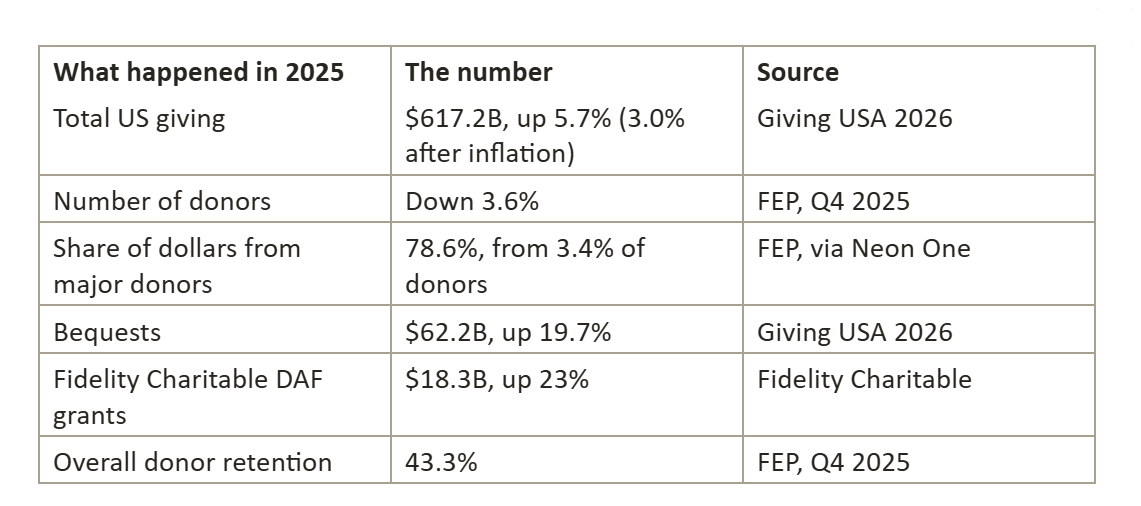
Last year, 3.4% of donors gave 78.6% of the money.
That figure comes from the Fundraising Effectiveness Project’s year-end 2025 report, and I think it is the most important number in fundraising right now. Total dollars rose 5.0%. The number of donors fell 3.6%.
Giving USA counted a record $617.2 billion for 2025, the first year over $600 billion. Almost all of the growth came from a thin slice at the top.
So every development shop has the same question in front of it for 2026. Out of the thousands of names in your database, which few dozen are ready for a real conversation this quarter?
I spent the last month working through the newest research: Giving USA 2026, the FEP reports, the 2025 Bank of America Study of Philanthropy, the 2026 donor-advised fund reports and the latest capital campaign data. Here is what it says, and what I would do about it.
Where is the money coming from in 2026?
Fewer, wealthier, more engaged donors are giving more, and more of it arrives through bequests, donor-advised funds and IRAs. In 2025, bequests rose 19.7% to $62.2 billion. Fidelity Charitable alone granted $18.3 billion. Individual giving grew just 1.4% after inflation. The donors who stayed gave more. Everyone else drifted.
If you have read Greg Warner’s Engagement Fundraising, none of this will surprise you. He built the whole method on the idea that a small share of your supporters will produce most of your revenue, and that your budget and your gift officers’ hours belong with them.
The 2025 numbers say that share is getting smaller.
Engagement predicts the gift better than capacity does
Every shop I know runs a wealth screen. A screen measures one thing: who could write a large check.
The 2025 Bank of America Study of Philanthropy, produced with the Lilly Family School of Philanthropy, surveyed 1,514 affluent households. Three findings matter here:
- Volunteers give more than twice as much as affluent donors who do not volunteer.
- Donors who describe themselves as experts on giving give more than six times as much as novices.
- Participation is falling at the top, too. 81% of affluent households gave in 2024, down from 91% in 2015, even as their total giving rose more than 30%.
In Engagement Fundraising (2018), Warner called volunteerism “the gateway drug leading to major giving and legacy gifts.” Seven years later the data backs him up. The donors who give the most are the ones who know you, work alongside you and understand the problem you are solving.
That is the logic behind MarketSmart. Supporters tell you in their own words, through a survey and through how they behave on your site, whether they want to talk, why they care and what kind of gift they are considering. MarketSmart’s Prioritization Pentagon checks five things before anyone lands on a gift officer’s caseload: timing, reason for giving, engagement, permission and capacity.
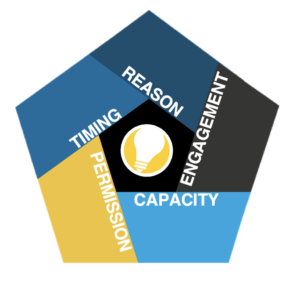
Capacity is 1 box out of 5. Most prospect lists treat it as the only one.
Two more findings make the case for letting donors raise their hand.
First, trust. Independent Sector’s 2025 survey found that only 29% of Americans have high trust in wealthy philanthropists. Wealthy donors know they are being watched. They respond to organizations that ask how they want to engage and then respect the answer.
Second, privacy. Only 2.3% of nonprofits use AI scoring to find mid-level, major or planned gift prospects (Nonprofit Tech for Good, January 2026). And in a Kindsight survey of healthcare donors, concern about how nonprofits use their data doubled in one year, from 31% to 63%. That is vendor survey data, so hold it loosely. Still, the direction is clear. A donor’s own words, given with permission, beat any model’s guess about her.
The middle is thinning, and it holds your next campaign
Donors giving $501 to $5,000 fell 1.5% in 2025, per the FEP. That sounds small. It is an early sign of a big problem, because today’s mid-level donor is the next campaign’s leadership prospect and the next decade’s bequest.
Retention tells the same story. Overall retention sat at 43.3%. In M+R’s 2026 benchmarks, online donors who gave for the first time retained at 24%, against 66% for repeat donors. Neon One’s data on 4,107 nonprofits shows recurring donors retaining at 78% to 80%, against about 32% for one-time donors (vendor data, but consistent with everything else I see).
Here is why this matters for an engagement program. A traditional RFM model never surfaces the $250 donor who has volunteered for 12 years and quietly named you in her will.
An engagement survey goes to everyone, including mid-level donors, lapsed donors and volunteers who have never given at all. Some of the best prospects on a MarketSmart dashboard are people the major gift team has never heard of.
Capital campaigns now ride on about 20 gifts
Capital Campaign Pro’s 2026 State of Capital Campaigns report (650+ organizations, self-reported) found that the top 20 gifts produced 72% of campaign goals. Board giving averaged about 15%.
At the very top, Marts & Lundy counted 355 gifts of $10 million or more in 2025, up from 322, with the average rising to $14.18 million. The number of those donors who used a planned giving vehicle rose from 22 to 33.
So a feasibility study comes down to one question. Can you name 20 people, with known capacity and real affinity, who together cover roughly three-quarters of the goal?
Build the gift chart from those names up. A chart built from ratios down, with no names attached, is a wish list.
This is where engagement data earns its keep before a campaign starts. Run a survey 12 to 18 months ahead of the quiet phase. You will learn who already thinks of your organization as a top philanthropic priority, who wants a conversation, and who is considering a gift through a will, a DAF or an IRA. That is a better starting list than a screen alone.
One more finding from the same Capital Campaign Pro report should calm your board. 75.5% of organizations held or grew their annual fund during an active campaign, and only 12% saw it drop afterward. A campaign is a fine time to grow the annual fund.
Ask about the will, the DAF and the IRA
The fastest-growing money in 2025 moved through three channels.
Bequests rose 19.7% to $62.2 billion and supplied about a third of the year’s growth. Realized bequests reached 23.7% of personal giving to colleges and universities, a record, per CASE.
Donor-advised funds set records at all three national sponsors. Fidelity Charitable granted $18.3 billion (up 23%), DAFgiving360 $9.9 billion (up 28%) and Vanguard Charitable $3.9 billion (up 27%). Fidelity reports that 77% of its grants went to charities donors had already supported. DAF money follows relationships.
IRA qualified charitable distributions are the best-protected gift in the tax code for 2026. The limit is $111,000 per IRA owner age 70½ or older, and QCDs sit outside the new tax law’s limits entirely.
Those new limits matter less than the headlines suggest. Starting in 2026, itemizers can deduct gifts only above 0.5% of income, and top-bracket donors get 35 cents of tax benefit per dollar instead of 37. For a top-bracket donor, the after-tax cost of a $1 gift moves from 63 cents to 65 cents. The Lilly School and CCS estimate a net loss of $5.69 billion a year, under 1% of total giving.
Two cents on the dollar is no reason to lower a campaign goal. Change how you structure the asks instead:
- Pair every leadership pledge with a conversation about an estate gift.
- Allow uneven or every-other-year pledge payments for donors who bunch gifts to clear the new floor.
- Add language to pledge agreements that allows payment from a DAF.
- Ask every leadership donor over 70½ about a QCD.
A good engagement survey asks supporters which of these vehicles they already use. Read the answers with care, though. Warner warns in the book that what donors say “isn’t always true,” and he means it in both directions. Some people who say no to a legacy gift have already made one. Behavior on your site (a downloaded will-planning guide, a second visit to the page on beneficiary designations) tells you as much as the checkbox does.
Plan for a soft year-end 2026
Donors pulled gifts forward into December 2025 to beat the tax changes. FEP growth ran 3.7% through the third quarter and finished at 5.0%. National Philanthropic Trust saw December DAF grants jump 112%.
The first quarter of 2026 looked steadier: dollars up 4.3%, donors down only 0.8%. But the FEP itself warns the second half of 2026 could be softer, and RKD Group’s mid-year survey found 69% of donors expect a recession within 12 months.
Budget 2026 on a 2- or 3-year average, and tell your board now, before the December numbers land.
What I would do this quarter
- Name your top 20. For any campaign in planning, list the 20 prospects who could cover three-quarters of the goal. If you cannot, the goal or the timeline needs work.
- Ask, then answer fast. Survey your whole file, and follow up personally with everyone who raises a hand. Warner calls lead generation without a cultivation plan “almost a complete waste of time and resources.” I agree.
- Find the parked money. Ask leadership donors whether they funded a DAF in 2025 and how much of it is still waiting to be granted.
- Make legacy part of every leadership ask. The bequest numbers support it, and so does the rise in $10 million-plus donors using planned vehicles.
- Protect the middle. Fund recurring giving and mid-level stewardship as campaign infrastructure. That is where your next top 20 comes from.
- Put both spouses in the room. In the Bank of America study, 46% of affluent households make giving decisions jointly.
From Donor Data to Donor Readiness
The research points in one direction. Spend more time with fewer people, and let those people tell you when they are ready.
The challenge for advancement teams isn’t simply identifying donors with the capacity to make a major gift. It’s recognizing which donors are interested, engaged and ready for a meaningful conversation.
That opportunity may already exist in your database. The question is whether you have the information you need to recognize it.
MarketSmart’s complimentary Opportunity Analysis can help you understand the major gift potential within your existing donor base and where there may be opportunities worth exploring.
Discover the opportunity in your donor database.
Sources
- Giving USA 2026: giving rose to $617.2 billion in 2025
- AFP, Fundraising Effectiveness Project, Q4 2025
- AFP, Fundraising Effectiveness Project, Q1 2026
- Neon One, Q4 2025 FEP takeaways
- Lilly School, 2025 Bank of America Study of Philanthropy
- Independent Sector, trust in nonprofits 2025
- Nonprofit Tech for Good, AI and fundraising, January 2026
- AHP, healthcare donors and AI
- M+R Benchmarks 2026
- Neon One recurring giving research, April 2026
- AFP on Capital Campaign Pro’s State of Capital Campaigns 2026
- NonProfit Times, Marts & Lundy report on 2025 gifts of $10M+
- CASE, college and university giving FY2025
- Fidelity Charitable 2026 Giving Report
- DAFgiving360 2025 results
- NonProfit Times, Vanguard Charitable 2025
- University of Minnesota Foundation, 2026 QCD limit
- CCS Fundraising, Philanthropy Outlook 2026
- Chronicle of Philanthropy, year-end giving to DAFs, March 2026
- RKD Group, mid-year 2026
Jason B. Wood is the founder and principal of Cairn Philanthropy, a Kansas City-based consultancy providing senior fundraising counsel to nonprofits on feasibility studies, campaign strategy, development planning, and board engagement. Throughout his career in major gifts and campaign leadership, he has helped raise more than $300 million, including leading a comprehensive campaign, and previously served as Vice President of Philanthropy at Unbound. He holds an Executive MBA from Rockhurst University.